Fly anglers spend plenty of time considering rods, reels, lines, flies, and even netting material. But there’s another part of a landing net worth considering: the shape of the hoop.
The photo below shows four possible landing-net profiles. For this comparison, number them #1 through 4 with #1 being on the left.
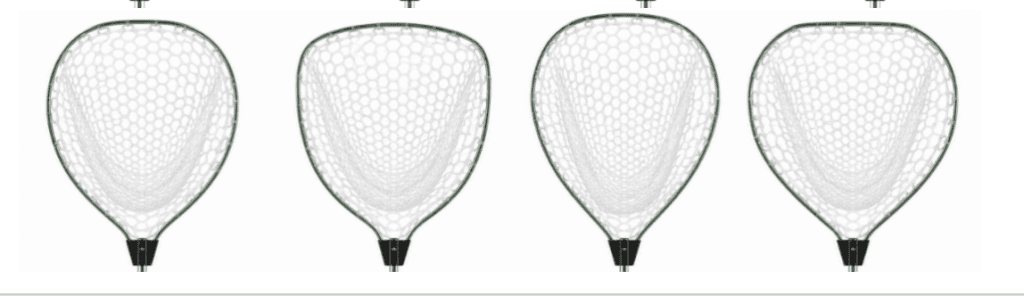
After comparing the four designs, I’d choose #3 for a fly-fishing landing net.
Here’s why.
Why I Prefer Shape #3
Shape #3 has a classic teardrop profile. The front of the hoop is broad and smoothly rounded, and the sides progressively taper toward the handle.
For me, that’s an appealing combination for a fly-fishing net.
The broad portion of the hoop provides a generous opening for guiding a fish into the net, but the hoop doesn’t remain at maximum width all the way back to the handle. Instead, the frame gradually narrows toward the yoke.
That produces a relatively compact profile while retaining a substantial opening.
Teardrop-shaped hoops aren’t unusual in fishing nets. Frabill, for example, describes its Rubber Wading Net as having a “popular teardrop hoop shape.” One version measures 12 by 16 inches and uses rubber netting.
Are Flat-Front Nets Worse?
Not necessarily, and this distinction matters.
Shapes #2 and #4 have noticeably flatter fronts. That produces a somewhat squarer profile than the continuously rounded end of #3.
A wider, squarer hoop can have its own advantages, particularly if the design objective is maximizing the available opening.
So I wouldn’t argue that a flat-front net can’t land fish effectively or that a teardrop is automatically superior.
For the type of fly-fishing hand net I’m considering, however, I prefer the continuously curved front and progressive taper of #3.
Rather than having a relatively straight front followed by more noticeable transitions into the sides, the front and sides of #3 form a smooth curve.
It also gives the net the compact, recognizable profile I associate with a traditional fly-fishing and trout landing net.
Why Not Shape #1?
This is the more interesting comparison because #1 and #3 are both essentially teardrop designs.
In fact, #1 would be my second choice.
Look closely at the sides of the two hoops.
Shape #1 remains relatively full and rounded farther down the hoop before turning inward more noticeably as it approaches the handle.
Shape #3 has a more progressive taper. Starting from the broad rounded end, the sides transition more continuously toward the narrower yoke.
The difference isn’t dramatic, and I wouldn’t expect the shape alone to transform how a landing net performs. But when selecting between these four profiles, I prefer the proportions and continuous taper of #3.
How Does That Compare With Commercial Fly-Fishing Nets?
Current commercial nets demonstrate that there’s no single mandatory shape for a good fly-fishing landing net.
The Fishpond Nomad Yampa Hand Net, for example, has an 18.2-by-11.2-inch hoop, a 9-inch handle, and a 12-inch-deep bag. Fishpond describes the hoop as compact and specifically says its compact shape helps minimize snagging on trees and bushes. The company positions the net for walk-wade fishing.
That’s an important consideration for anyone hiking or wading with a net hanging from a pack or vest. A large opening can make netting a fish easier, but a larger hoop also makes the net less compact.
Frabill takes another established approach with its Rubber Wading Net. Frabill describes the 12-by-16-inch hoop as teardrop-shaped.
Those commercial examples reinforce an important point: hoop shape involves trade-offs rather than one universally superior design.
Hoop Shape Isn’t the Whole Story
I wouldn’t purchase a fly-fishing landing net based on hoop shape alone.
The hoop’s dimensions may matter just as much.
A great teardrop profile that’s too small for the fish being targeted won’t be particularly useful. Conversely, an unnecessarily large hoop becomes more cumbersome to carry through brush or while wading.
Other factors I would consider include:
- Hoop length and width
- Net-bag depth
- Handle length
- Frame weight
- Netting material
- Overall dimensions when carried
For example, Fishpond’s current Nomad Yampa Hand Net demonstrates how these measurements work together. Its 18.2-by-11.2-inch hoop pairs with a short 9-inch handle and 12-inch bag, creating a net intended for compact walk-wade use.
Don’t Confuse Hoop Shape With Bag Shape
There’s another distinction worth making.
The hoop is the rigid frame around the opening.
The bag is the netting suspended from that hoop.
Those are separate design decisions.
A landing net can have a teardrop-shaped hoop while using a different net style or depth underneath. Frabill, for example, offers teardrop-hoop designs while also emphasizing netting characteristics on its various models.
When evaluating a catch-and-release fly-fishing net, I would therefore look at the hoop and the bag separately rather than assuming the hoop shape determines the entire design.
My Choice: Shape #3
There’s nothing inherently wrong with the other three profiles.
My decision comes down to what I want from this particular fly-fishing net.
Shape #3 gives me the combination I prefer:
- A broad opening
- A smoothly rounded front
- A gradual taper toward the handle
- A relatively compact overall profile
- A traditional teardrop appearance
Shape #1 comes very close, and anglers who prefer a fuller hoop might choose it instead. Shapes #2 and #4 offer broader, flatter fronts that reflect a different design approach, not a bad one.
But if I were choosing one of these four profiles for a general-purpose trout and fly-fishing landing net, I’d choose #3.