When you’re cruising on an e‑bike at 20–28 MPH, stopping power stops being a “nice‑to‑have” and becomes a core safety feature. Yet most budget e‑bikes still ship with mechanical disc brakes. They work, technically—but the gap between mechanical and hydraulic brakes is much bigger than a line on a spec sheet. It’s the difference between stopping smoothly and hoping you stop in time.
To understand why, it helps to look at how each system works and what that means for real‑world riding.Mechanical Disc Brakes: Simple, Affordable, and Limited
Mechanical disc brakes rely on a steel cable to pull the brake caliper when you squeeze the lever. It’s the same basic system used on traditional bicycles, and it’s popular for one reason: cost.
Pros of Mechanical Brakes
- Affordable and keeps bike prices down
- Easy to service or adjust at home or at any bike shop
- Compatible with nearly all bike frames
Cons of Mechanical Brakes
- Cable stretch reduces performance over time
- Typically only one pad moves, causing uneven wear
- Requires more hand force, especially at higher speeds
- Performance drops in rain, mud, or cold conditions
- Stopping power becomes inconsistent as cables collect grit
Mechanical brakes can stop a bike, but on a 60–80 lb e‑bike moving at 28 MPH, “can stop” isn’t the same as “can stop confidently.”
Hydraulic Disc Brakes: Stronger, Smoother, and Built for Speed
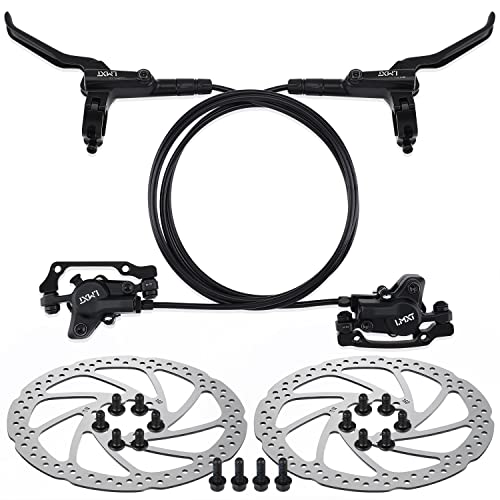
Hydraulic brakes use a sealed, fluid‑filled system. When you squeeze the lever, pressure from the fluid travels through the fluid and pushes both brake pads evenly against the rotor. This design is more efficient and more consistent.
Pros of Hydraulic Brakes
- Stronger stopping power with less hand effort
- Both pads engage simultaneously for smoother braking
- Self‑adjusting as pads wear down
- Consistent performance in all weather conditions
- Better modulation for precise control
Cons of Hydraulic Brakes
- Higher cost
- More complex maintenance, requiring occasional bleeding
- Rare potential for fluid leaks if seals fail
For riders who value reliability—especially at higher speeds—hydraulic brakes offer a level of control mechanical systems simply can’t match.Which Should You Choose?
If you ride casually at low speeds, mechanical brakes may be good enough. They’re inexpensive, familiar, and easy to maintain.
But if your e‑bike regularly hits 20–28 MPH, or if you ride in traffic, on hills, or in wet conditions, the difference becomes dramatic. Hydraulic brakes provide shorter stopping distances, more predictable braking, less hand fatigue, and better performance in all weather conditions.
On a heavy, fast e‑bike, those advantages translate directly into safety. Recommendation
For modern e‑bike riders—especially anyone traveling above 20 MPH—hydraulic disc brakes are the clear choice. The improved stopping power, smoother modulation, and all‑weather consistency make them worth the upgrade. Mechanical brakes may save money upfront, but hydraulic brakes pay you back every time you need to stop quickly and confidently.